Computational medicine
Machine learning and optimization for radiotherapy, medical imaging, and clinical diagnostics.
Our work in medical technology spans radiotherapy planning, diffusion MRI, and breast cancer diagnostics—each an active area where principled computational methods make a concrete clinical difference.
Radiotherapy planning
Radiotherapy planning is complex and time consuming. At Elekta, we did the research groundwork for the next-generation treatment optimizer for Leksell Gamma Knife Lightning, a commercial radiosurgery planning system used worldwide. This included new convex surrogates for common clinical objectives, techniques for reducing problem size, AI-powered problem compression, and methods for automatically assigning weights based on historical treatment data. We also developed a method that incorporates delivery constraints directly into a neural network, ensuring predicted treatment plans are actually realizable. This work resulted in 11 granted US patents. We continue to work on radiotherapy optimization, currently through a VINNOVA-funded project with Elekta on data-driven decision support.
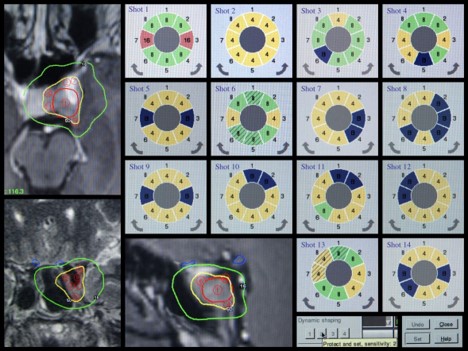
Gamma Knife treatment planning: MRI scans with dose contours (left) and the corresponding dynamic sector configurations (right).
We also developed a parallel ADMM algorithm for the LP formulation used in Gamma Knife Lightning, enabling interactive Pareto navigation of clinical trade-offs by optimizing hundreds of plans with different objective weightings—achieving speedups of up to 1500x on GPU compared to the simplex solver.
Selected references
- Sjölund J, Riad S, Hennix M, and Nordström H. A linear programming approach to inverse planning in Gamma Knife radiosurgery. Medical Physics (2019).
- Mair S, Fu A, and Sjölund J. Efficient radiation treatment planning based on voxel importance. Physics in Medicine & Biology (2024).
- da Silva J, Hernández Escobar D, Kjellsson Lindblom T, Nordström H, and Sjölund J. A parallel algorithm for generating Pareto-optimal radiosurgery treatment plans. Medical Physics (2026).
Diffusion MRI
Diffusion MRI is a useful probe of tissue microstructure, which can be used to derive biomarkers for diagnostics and treatment. In collaboration with Filip Szczepankiewicz and others, we developed the open-source library NOW that has established itself as the de facto standard tool for gradient waveform design for tensor-valued encoding in diffusion MRI. Since its introduction in 2015, the methodology and software has been extended and refined to capture additional effects, including Maxwell compensation, motion compensation and cross-term compensation.
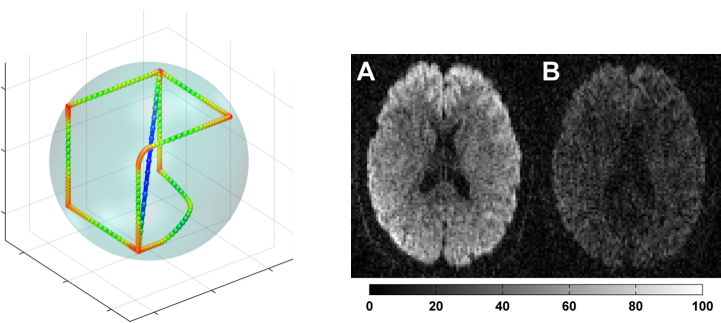
Optimized gradient waveforms (left) enable tensor-valued diffusion encoding, revealing microstructural information in the brain (right).
Selected references
- Sjölund J, Szczepankiewicz F, Nilsson M, Topgaard D, Westin C-F, and Knutsson H. Constrained optimization of gradient waveforms for generalized diffusion encoding. Journal of Magnetic Resonance (2015).
- Szczepankiewicz F, Sjölund J, Ståhlberg F, Lätt J, and Nilsson M. Tensor-valued diffusion encoding for diffusional variance decomposition (DIVIDE): Technical feasibility in clinical MRI systems. PLoS One (2019).
Breast cancer diagnostics (AID4BC)
We participate in the AID4BC consortium, a multimodal AI initiative focused on precision diagnostics and decision support for breast cancer. Our contribution, together with Dave Zachariah at Uppsala University, centres on multimodal machine learning methods and causal foundations for internally and externally valid clinical decision-making. Together with the other partners—Karolinska Institutet, Lund University, Linköping University, and industry partners Sectra and Stratipath—we are building the world’s largest multi-site and multi-modal breast cancer study (N > 10,000).